

American Corrections cost you $270 billion last year
Here are your 2025 tax forms

This is my version of middle-age—
An ever increasing desire to scale the steps of my Capitol building and flip someone off to their face.
If you know, you know.
In my home, I am the malcontent who obsessively clears the countertops of where-did-all-of-this-come-from, the maniac who purges the junk drawer and bathroom cabinets, the house-elf who throws away the leftovers while muttering and sighing.
I am also the one who neatly gathers our tax forms into a clean manila envelope every year.
As the 2025 statements came rolling in over the past two months, I felt every bit of my age. And while complaining about taxes is the very thing that birthed our modern nation (and remains a national pastime), my irritation is very specific—
I wrote a $720 check last year to fund incarceration. So did my husband.
And so did you.
Of course, if we factor in the costs for community policing and courts, it's more like $1,700. Worse—that’s more than we paid for our local libraries, fire departments, emergency services, and local parks combined in 2025.
“Well, that's the price of keeping our neighborhoods safe,” you say. “If that is what it takes to keep criminals off of my street, I'll pay double.”
And to that, my inner Columbo smiles and interjects—
It’s just… one little thing.
Probably nothing but what’s bothering me is…
If safety was the end-product, I wouldn't feel so hesitant to let my seven year old ride his bike in our neighborhood without me. If investing in Corrections led to actual Correction, the system would be ever-shrinking, not expanding.
What Are We Doing?
You can argue that you might be willing to pay more in taxes to be saved from the likes of my criminal drug-using son (45% of prisoners are in for non-violent crime) but from where I sit, that’s just piss-poor budgeting.
Prison is one of the LEAST cost-effective ways to improve community safety, and 95% of our incarcerated folks are coming home anyway.
While we are toiling to pay top dollar for the construction and maintenance of more state-run cages, our young and impulsive citizens pace their days into less employability. Our tax money is contributing to recidivism and more violence—and collectively, we keep signing the annual contract.
While I’m not going to use this piece to explore alternatives like drug treatment over prison, there's a valuable point to add here: Every $1 spent on substance use treatment saves $4–$7 in reduced crime and criminal justice costs1—and we haven’t even gotten to exploring what investments in options like job training, housing, home detention, and expanded youth programs could do for our collective well-being.
No, instead we accept headlines like these:
“Alabama's new super-sized prison is costing over $1 billion to build”2
“Utah spent $1 billion to build a new prison. Now, lawmakers want $130 million more.”3
“ICE’s Largest Prison Contractors Hail ‘New Growth Opportunities’ as Revenue Reaches All-Time High”45
“MDOC tells appropriations subcommittee it faces more than $320 million in five‑year facilities needs”6
And why is MDOC hitting up Michiganders for more cash when their corrections budget is already $2.2 billion per year? Because it is an industry. Roughly 75–80% of MDOC correction spending goes to:
Officer salaries
Overtime
Pensions
Healthcare benefits
And here’s the real throat punch—
When prisons are understaffed and corrections officer overtime skyrockets, we are the ones paying time-and-a-half to keep it all running. In most states, corrections overtime has exploded into hundreds of millions each tax cycle.
Meanwhile, only 3% of the corrections budget addresses mental health or programming created to facilitate rehabilitation of the people we are incarcerating.
Shame on us.
Shame on every single one of us.
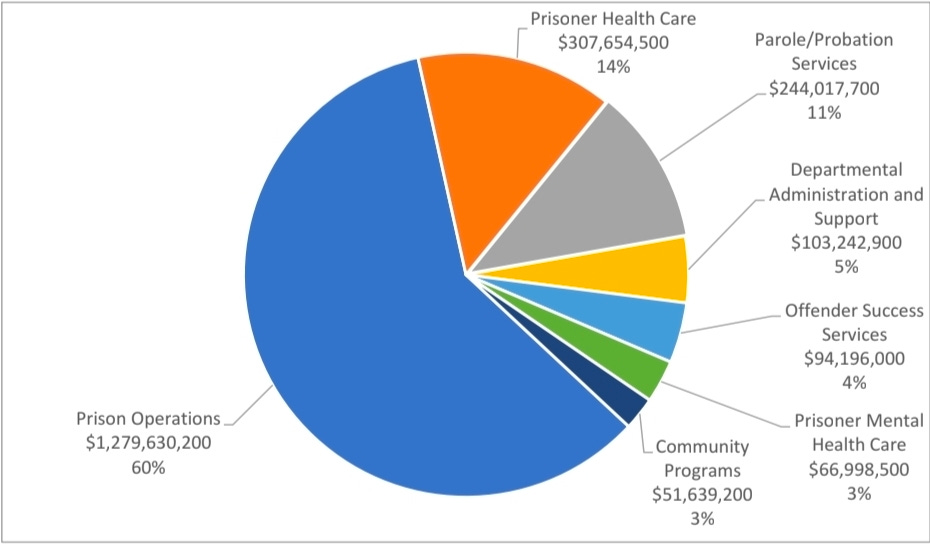
If you are a long-time reader, you may recall my two-part series on the real financials of American incarceration.
In Part One, Coffee is Life, I exposed the amount of money that my family pays out-of-pocket for things like coffee, deodorant, and shower shoes (none of those are included in a prison stay). Just this week, I overheard my son bartering for coffee during one of our phone calls (he had run out on Monday and his next store doesn't come until today). The other inmate didn't want or need his powdered milk product, so no deal. It crushed me to learn that he is trading his breakfast this week for a single shot of coffee every morning (this morning he gave away a tray of something that resembled biscuits and gravy).
In Part Two of my financial series called Eat the Rich, I exposed the opportunistic money grubbers (by name) who have created and enjoyed monopolies (and bought yachts and Lambos) at your tax dollar expense. According to Time Magazine this month, two of the largest prison profiteering corporations raked in over $4.8 BILLION in total revenue in 2025. And we paid them that money.7
Here’s what those folks are contributing to society:
Alabama taxpayers are building a massive new prison, with costs ballooning to about $1 billion (plus) for multi-thousand-bed facilities.
South Dakota taxpayers have earmarked funds that could total up to $2 billion over the next decade on new prison construction.
Indiana taxpayers recently broke ground on a $1.2 billion replacement correctional facility.
Pennsylvania’s State Correctional Institution (Phoenix) opened in 2018 after taxpayers laid out $400 million for it.
Seriously, what are we doing?
A new medium-security prison costs $100,000–$150,000 per bed, more than building a classroom for 30 students.
Annual inmate healthcare costs can exceed $10,000 per prisoner, more than what the average American spends on their own healthcare premiums.
Lifetime cost of incarceration per person: a single 5-year prison term can cost taxpayers $250,000.
If we knew of the wasted time, money, and talents inside our prisons, we would demand something different.
Bad Boys
I haven't faithfully watched the NBA since the Bad Boys era in Detroit. What with all of the tanking going on these days, who really cares anymore?8
Another product of my middle age status: I only consider The Pistons anymore from the vantage point of it being a franchise. The team’s owner, Tom Gores, also owns a California-based private equity firm called Platinum Equity. In 2017, he spent 1.6 billion to buy Securus Technologies. Together with Global Tel Link (a company that I am forced to use nearly every day)—Tom Gore’s Securus, controls over 80% of the prison phone and video call services in the United States.
To the tune of about $700 million in revenue every year.
Well, you say, it's a free market and Gore assumed the risk that others didn't. He's creating jobs and income for investors. This is the backbone of American commerce.
Okay, but just know you're paying the mortgage on his $100 million Beverly Hills property this year because in most states, prison phone call subsidies are taxpayer-funded.

Here’s another tax consideration:
Why would the GEO Group (a private corporation) buy out Behavioral Interventions Inc. of Colorado for $415 million?
Because BI Inc. (once a polygraph maker) manufactures electronic ankle monitors, GPS ping devices, and voice recognition devices. GEO oversees approximately 60,000 people on parole across all 50 states. Not satisfied with their current monopoly on prison operations, the GEO Group saw releases from prison to be a major cut in their profits so they grabbed up the parole supervision market as well. They are lovingly calling this the ‘alternatives to detention’ project.
Just imagine the money to be made in governmental ICE contracts right now— they must be frothing at the mouth.

So this is middle age—
I am actively working to find an investment firm that can handle my 401k portfolio without supporting prison profit. My current provider has told me No-can-do. If you invest in any funds at all, you're funding prison profiteers.
Why?
Because the hooks of American commerce are in nearly every aspect of the American Prison Machine. It is almost impossible to untangle your investments and retirement funds from the prison industry.
And I get it.
We work hard. We want to make the most return on our investments, and so be it if we keep ‘bad’ people locked up in order to do so. But—whether you care about prison reform or not, it is silly for investors (aka taxpayers) to put their fingers in their ears and turn a blind eye right now. Even if we are invested and enjoying a tiny little return on our money each year, the exchange of our peak employment years for the mess of recidivism that we get is an insult.
And please, my beautiful friends, don’t knee-jerk into blaming the Republicans. That’s a wear out. The 1994 Crime Bill, which guaranteed longer sentences (and therefore more prison profit), was championed by a democratic-controlled Congress and Clinton’s White House. You should also know that ICE and immigration detention skyrocketed under Obama’s leadership through his no-bid/closed-door contracts with Civic Core and GEO Group. Obama’s tenure saw over 3 million individuals detained and deported—more than any other administration to date, including Trump’s two terms.
The truth is that there isn’t a clean political party here—even when Biden pledged to end federal private prison use in 2021, his order left out immigration detention (which is a huge share of private contracts). He practically laid out a red-carpet for Trump to build more detention centers this year, and build he has.
No one is coming to save us.
My goal is for us to be informed enough that we are willingly lining the Gucci pockets of billionaires. If you don’t care that the taxpayer price tag for American Corrections currently rings up at $270 billion a year, you can close this tab and move along.
For the rest of us thinkers and feelers and helpers, we either start to understand why prison populations have exploded in recent decades or we don't. We either wonder why we are building prisons at a break-neck pace in rural America or we don't.
And, good people, here are some concrete things that you can do today to scale the steps of your Capitol and stay informed or flip someone off:
Check Your State Legislature’s Budget or Committee Pages
Every state has an official legislative website with:
Hearing schedules
Committee agendas
Links to livestreams or archived broadcasts
For example, some states publish annual joint budget hearing calendars that list topics, times, and how to submit testimony. These are often under their Senate/Assembly Finance or Appropriations committee sections. In New York, for instance, the 2026 budget hearing schedule was announced publicly and includes dates and subject areas.
How to find yours:
Search for your state’s legislature website (e.g., “Texas Legislature hearings schedule” or “California state budget committee schedule”).
Look for pages labeled: Budget, Appropriations, Finance, or Corrections.
Most sites let you filter by topic (e.g., “Corrections”).
Look for Appropriations / Corrections Budget Hearings
Budget hearings that affect corrections spending are usually held by:
Appropriations Committees
Finance or Budget Subcommittees
Judicial & Public Safety Subcommittees
Some states have schedules posted in advance showing when these committees will take public testimony — including an item for the Department of Corrections or Judiciary budgets.
Sign Up for Alerts and Testimony Notices
Most state legislatures let you:
Subscribe to committee calendars
Receive email alerts when hearings are scheduled
Register to submit written testimony or testify in person
Contact Your Legislators or Legislative Staff Directly
If you’re having trouble locating a schedule:
Call or email your state senator/rep’s office
Ask for the corrections or prison budget hearing dates
Ask how to register to testify or submit written comments
Legislative staff are generally responsible for managing hearing schedules and can point you to the right calendar.
Request a full holdings report from your 401(k)/IRA provider and screen it for exposure to private prison companies (e.g., CoreCivic, GEO Group) or public safety/corrections ETFs, then shift those allocations into ESG or custom-index funds that explicitly exclude private prisons and detention operators.
Can you imagine what we could do if we all did these things together? Have other ideas for us? Please drop us a note in the comments!
https://nida.nih.gov/sites/default/files/podat-3rdEd-508.pdf
The Salt Lake Tribune, Feb. 10, 2026
Time Magazine, Feb. 12, 2026
“GEO Group, which operates 19 facilities for ICE around the country, reported $2.6 billion in total revenue in 2025, up 6% from $2.43 billion in 2024. CoreCivic, which owns and operates at least ten ICE detention facilities, reported $2.2 billion in total revenue in 2025, up 13% from $1.96 billion in 2024.” See article in footnote #3.
Tanking (NBA): The unofficial strategy of losing on purpose to improve draft lottery odds and secure a franchise-saving prospect.
https://bjs.ojp.gov/library/publications/time-served-state-prison-2018-supplemental-tables
This is one of your best posts ever. Thank you for all the time you put into it. Like you said, if the system was working, it would be shrinking, not growing. We the taxpayers need to see when a system like healthcare or the prison system has a perverse incentive to increase the problem it is paid to stop. We are rewarding the wrong behavior with our tax dollars.
I have come to believe that the so-called 'war on drugs' is nothing more than an economic enrichment scheme. More police. More jails. More prisons. More staff for all of those. I could go on forever.